What actually happens when a fresco dries
True fresco, called buon fresco in Italian, is painted with pigment ground in water and applied directly onto a thin top layer of wet lime plaster called intonaco. As that plaster sets, the calcium hydroxide inside it reacts with carbon dioxide from the surrounding air and converts into calcium carbonate, a chemical change that locks the pigment inside a hardened crystalline surface, not left sitting on top the way oil paint would be. A University of Southern California engineering write-up on the process describes the plaster layer as porous enough for that carbon dioxide to diffuse in and react with the dissolved lime, effectively growing a durable stone surface around the pigment as it cures.
That same chemistry sets a hard deadline. Once the plaster stops absorbing water, it stops absorbing pigment too, so a painter has to finish an entire section, called a giornata, in a single working day, with no way to blend or revise once it sets. Michelangelo's crew on the Sistine Chapel ceiling learned this the difficult way in 1508, when a lime-and-pozzolana plaster mix stayed wet too long in Rome's damp air and grew mold across an entire finished section before it could cure, forcing the team to scrape the plaster back and start over with a standard lime-and-sand mix.
Because the bond is chemical, not just visual, a genuine fresco surface and later paint added on top of it after the plaster has already cured age differently and can, in principle, be told apart. That distinction turns out to matter more than most visitors to the ancient world's most reproduced frescoes realize, because several of Bronze Age Crete's signature images were extensively completed by restorers, not simply recovered whole, some within a few years of excavation and one only decades later, all working for the same excavator.
The most reproduced Minoan fresco is a modern collage
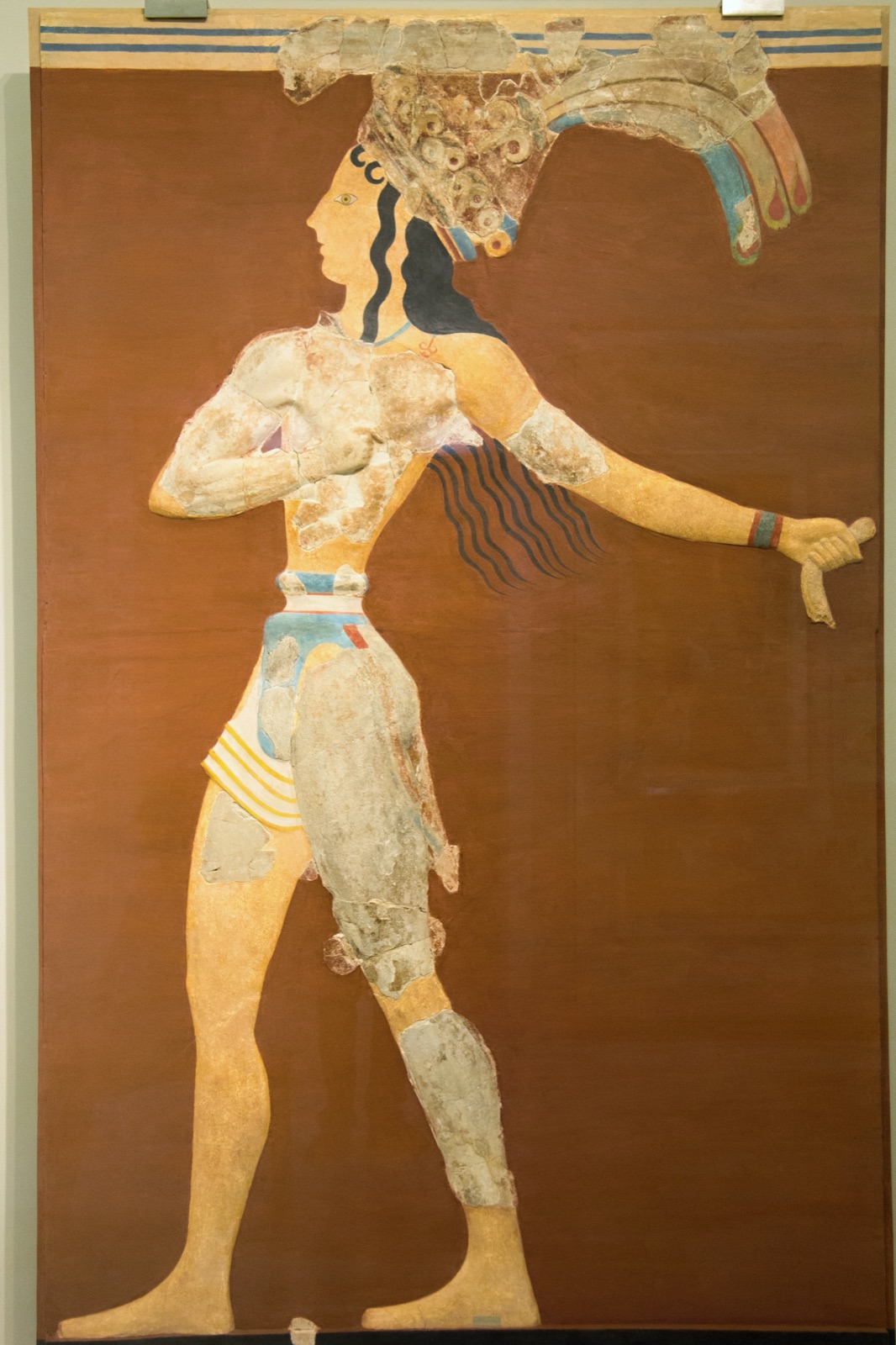
The image most people picture when they hear "Minoan fresco" is the Prince of the Lilies: a slim, muscular figure crowned with lilies and peacock feathers, striding through a garden with one hand on his chest, usually captioned as a Knossos priest-king from around 1500 BC. It is reproduced on postcards, book covers and museum posters well beyond its home in the Archaeological Museum of Heraklion. The fragments were excavated by Arthur Evans's team at the palace of Knossos in the early 1900s, and the crown, the torso and the legs turned up apart from one another in different parts of the site.
The striding, unified prince now on display was assembled from roughly nine separate pieces in 1905 by the Swiss restorer Émile Gilliéron (1850-1924), working for Evans. His son, Émile Gilliéron fils (1885-1939), later made a second copy of the finished composition in 1926 for display elsewhere in the reconstructed palace. Wikipedia's summary of the scholarship notes that many specialists argue the crown, the torso and the legs probably came from different paintings, and possibly from different figures entirely, not the single striding prince Evans's team put together. A 2024 paper in the Annual of the British School at Athens by Ute Günkel-Maschek of Heidelberg University took up one specific piece of that dispute, a rival theory that the torso fragment, formally catalogued as the "male torso with the lily collar," actually belonged to a right-facing boxer or deity rather than the traditional left-facing striding man. Comparing the necklace on the torso with how similar jewelry appears in other Minoan images, Günkel-Maschek's analysis sided with Evans's original orientation, concluding the traditional reading should "regain its central place" in Minoan art, not lose ground to the boxer theory. The 45-year-old argument over which way this one torso faces remains a live scholarly debate; the 2024 paper only closes one round of it.
The garden motifs, the crown and the muscular torso are all real ancient paint on real ancient plaster. Joining them into one striding person was an editorial decision Gilliéron made in 1905, not something anyone dug out of the ground fully formed, and which way that person is facing is still being argued over in academic journals more than a century later.
The women in blue never had faces to begin with
The Ladies in Blue fresco, showing women in elaborate hairstyles and jewelry against a blue ground, has a more literal version of the same problem: none of the original heads survived at all. Whatever the missing heads actually looked like, the faces visitors see today were supplied by Gilliéron fils from his own imagination, following the same method used on the Prince of the Lilies, take a handful of fragments believed to belong to the same scene and complete whatever is missing by eye.
The bull-leaping fresco, often called the Toreador Fresco and reproduced just as widely, has a different kind of gap: not in what survives, but in how many scenes the surviving pieces actually show. Evans and Gilliéron combined the largest fragments from at least seven separate painted panels into the single composition now displayed, one charging bull and three human figures. The archaeologist Mark Cameron later proposed a different reading of the same fragments: four similar but separate bull-leaping compositions, each with its own bull and its own trio of figures, repeated across the wall, not one continuous scene shown once.
The griffins on display don't match what was found
The griffin fresco flanking the alabaster seat in the Throne Room, unearthed by Evans in 1900 and long read as evidence that whoever sat there ruled beside two mythic guardian beasts, has its own documented mismatch. The griffins on the wall today were restored by the Gilliérons in 1913 and again in 1930, and for more than eighty years, that reconstruction was the closest thing anyone had to a primary source for what the original composition looked like.
In 2017, Yannis Galanakis, Efi Tsitsa and Ute Günkel-Maschek published a systematic re-examination in the Annual of the British School at Athens, working from archival material held at the Ashmolean Museum in Oxford alongside the surviving fragments in Heraklion. Their finding was that the version on the wall bears little resemblance to what was actually excavated: the best-preserved griffin fragment does not carry the curling neck plumes shown in Gilliéron's drawing and copied onto the wall, even though Evans had described those plumes in his own notes based on that drawing, not on the fragment underneath it. The team proposed a different original composition altogether: two overlapping griffins with no wings at all, set among papyrus plants, not the heraldic winged pair now framing the throne in every photograph.
Why the Gilliérons did this, and what it doesn't mean
None of this makes Evans a forger in the ordinary sense. He funded much of the Knossos excavation and its restoration from his own family fortune, which meant no outside board was checking how much license his restorers took, and early 20th-century archaeology had no shared professional standard yet for how much a restorer could add before a reconstruction stopped documenting a find and started arguing for what the excavator already believed had been there. It is a different problem from what happened to Romanesque frescoes stripped from Catalan churches in the same general period, where the fight was over who got to remove a fresco from a wall, not over what got painted back onto it.
None of this touches the archaeology of the palace itself. The room layout, the storage magazines, the drainage system and the Linear B tablets are excavated structure and inscribed clay, not painted plaster, and none of it depends on anything the Gilliérons drew. What is in question is specifically the painted surface of a handful of famous frescoes, reassembled and completed by two artists working from fragments, their own training in illustration, and Evans's confidence that he already knew what Minoan Crete had looked like.
Museum conservation today runs on the opposite premise: additions are supposed to be reversible and visually distinguishable from the original material, precisely so a later scholar with better evidence, or a better archive search, can undo them without having to guess what the fragment underneath actually showed. The 2024 study of the Prince of the Lilies and the 2017 study of the Throne Room griffins are what that later evidence looks like, arriving about a century after the plaster first set.