A gold engraver’s son, and what that meant for the paint
Gustav Klimt was born on 14 July 1862 in Baumgarten, then a village on the western edge of Vienna. The Klimt Foundation’s research database records his father, Ernst Klimt the elder, as a man who came to Vienna from Prague as a child and trained as a gold engraver. The family lost its savings in the speculation around the Vienna World’s Fair of 1873 and moved repeatedly when rent went unpaid. Gustav and his younger brother Ernst were nonetheless sent to the Imperial-Royal School of Arts and Crafts, transferring in 1878 into the class that trained academic painters.
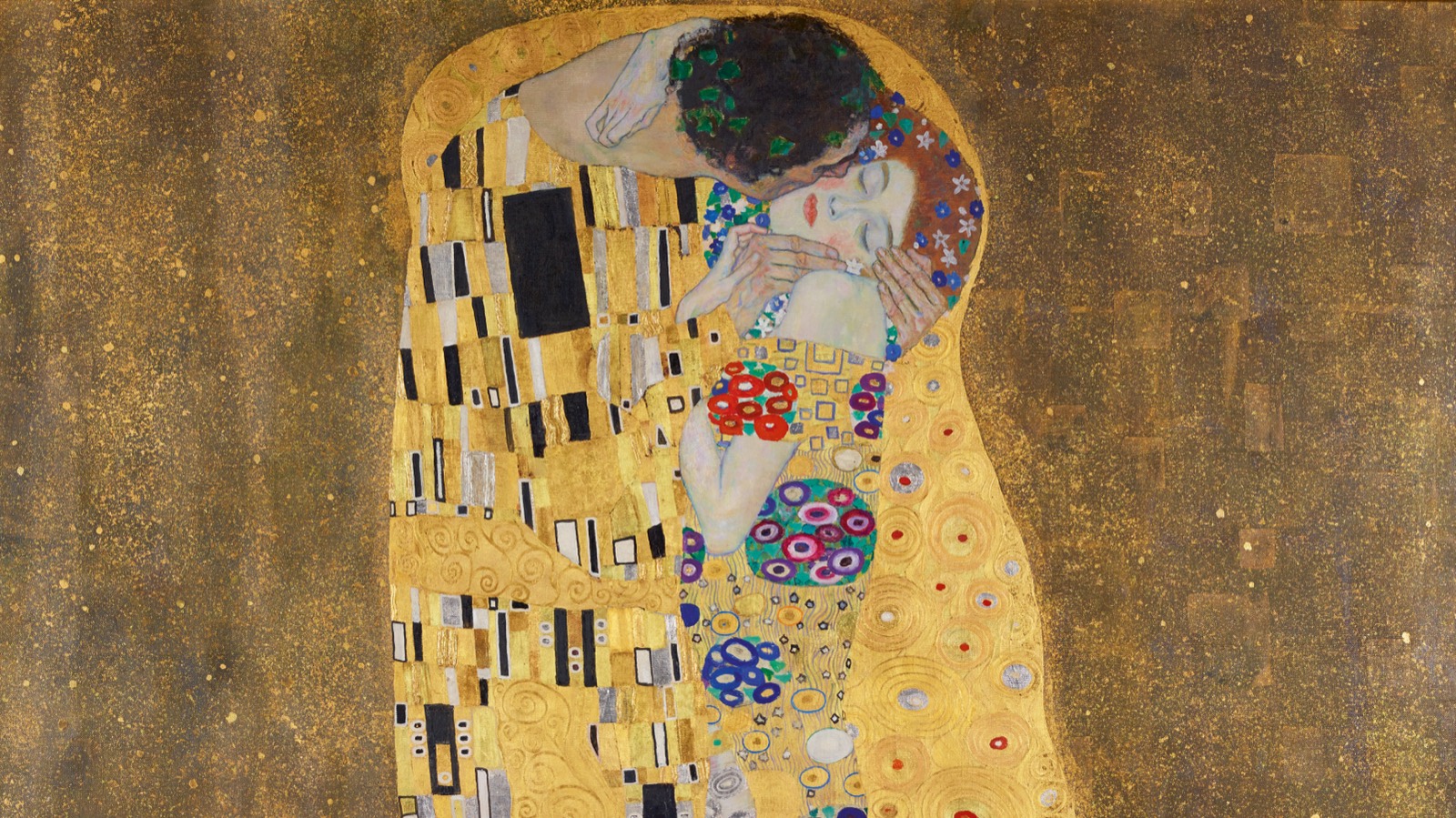
The trade background matters, because Klimt’s gold is not a figure of speech. The Belvedere’s catalogue record for The Kiss reads like a metalworker’s docket: gold leaf, silver leaf and platinum leaf in the two figures, worked into resin oil colours on a primed canvas. The background is a different material altogether. The museum lists it as Schlagmetall, brass composition leaf, glazed with translucent colour and then dusted with loose flakes of metal leaf. The most famous gold field in European painting is largely brass.
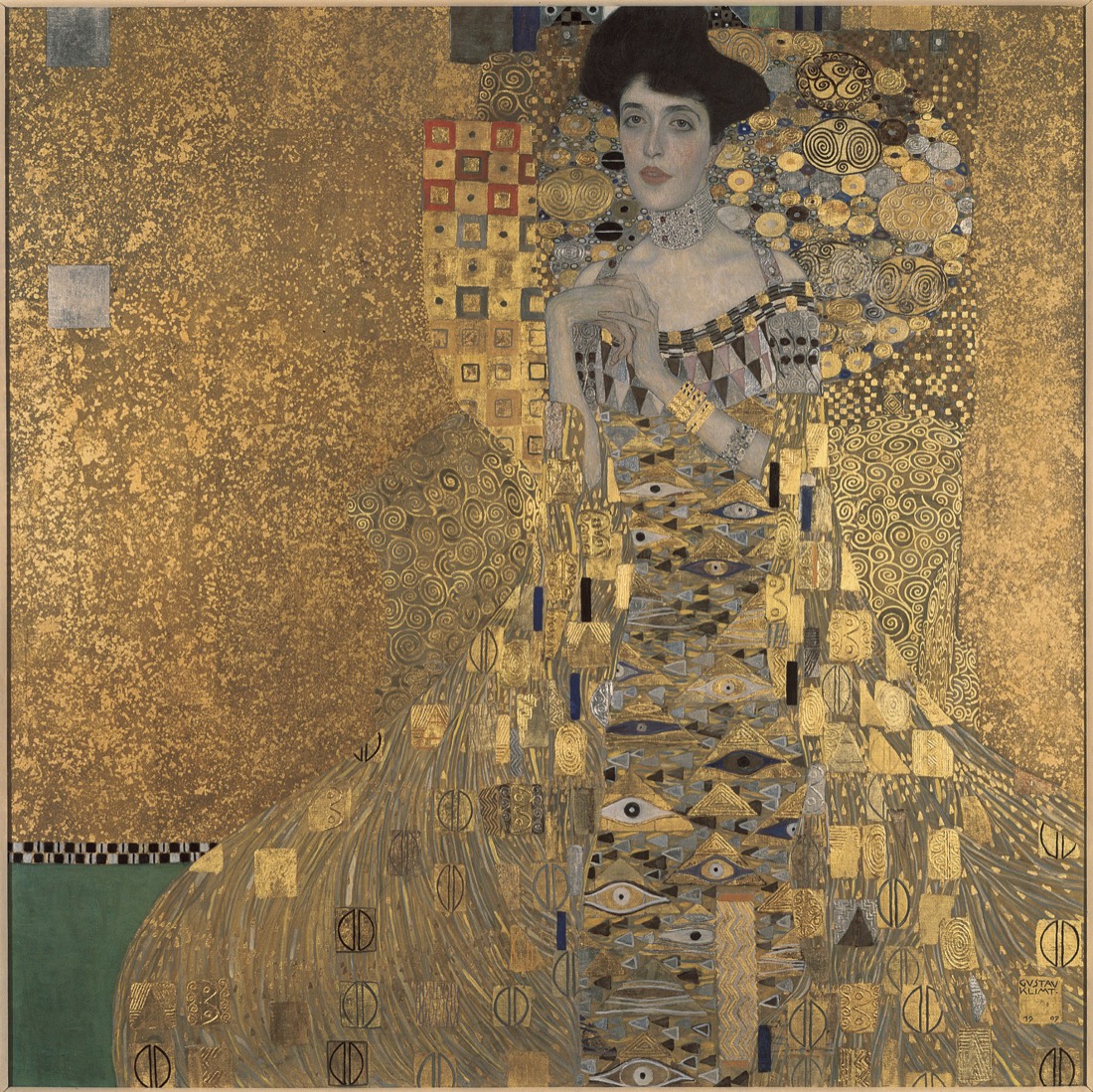
Klimt got the visual grammar for this from Ravenna. The Neue Galerie dates the decisive trip to December 1903, when he spent time in the sixth-century Church of San Vitale and studied the Byzantine mosaics of the Empress Theodora, and its account of Portrait of Adele Bloch-Bauer I traces the jewel-like inlays and layered metal of that portrait back to those walls. The gold pictures all fall in the years just after the trip. Klimt died in Vienna on 6 February 1918 at 55, after a January stroke left him partly paralysed and he caught pneumonia in hospital.
The Kiss was bought unfinished, and the ministry file says so
The Kiss went on public view for the first time at the Kunstschau Wien 1908, open from 1 June to 15 November, where it hung under the title Liebespaar, Lovers, facing the entrance of the room Koloman Moser had designed for Klimt.
It was not finished. A photograph Moriz Nähr took inside the exhibition shows bare patches in the lower left corner. That did not deter the Moderne Galerie’s committee, which resolved to buy the painting on 10 July 1908, with the Ministry of Culture and Education finding the money. The Belvedere’s catalogue essay by Franz Smola and Markus Fellinger quotes the note in the ministry’s acquisition file: „pro domo: die untere linke Ecke des Gemäldes von Klimt ist noch nicht ganz fertiggestellt.“ In translation, for internal purposes: the lower left corner of the painting by Klimt is not yet quite finished.
Klimt, on holiday at the Attersee, wrote back undertaking to take the picture home the moment the show closed and deliver it as soon as he could. He kept the promise and then went further. Set Nähr’s photograph beside the painting as it hangs today and the revisions are legible: the flowers at the left of the meadow strip, stylised clumps in 1908, were brought into line with the even scatter across the rest of it. One correction shows up only under X-ray: Klimt lengthened the kneeling woman’s lower legs by a few centimetres, so that they now break through the wavy edge closing off the gold field on the right. Vermeer's Milkmaid is another canvas whose X-rays keep finding things.
The agreed price was 25,000 crowns in two instalments. The ministry ordered the second on 29 June 1909, and the Moderne Galerie took delivery on 22 July 1909, still as Liebespaar. A gallery catalogue of autumn 1909 used the title Der Kuss for the first time. Those 25,000 crowns were the highest sum the gallery had paid for a work by a living artist, against the roughly 15,000 crowns Klimt was then getting for a society portrait. The Belvedere’s own essay raises the possibility that the ministry was making amends for what Klimt had been put through over the faculty paintings.
Three ceiling paintings that no court can reach
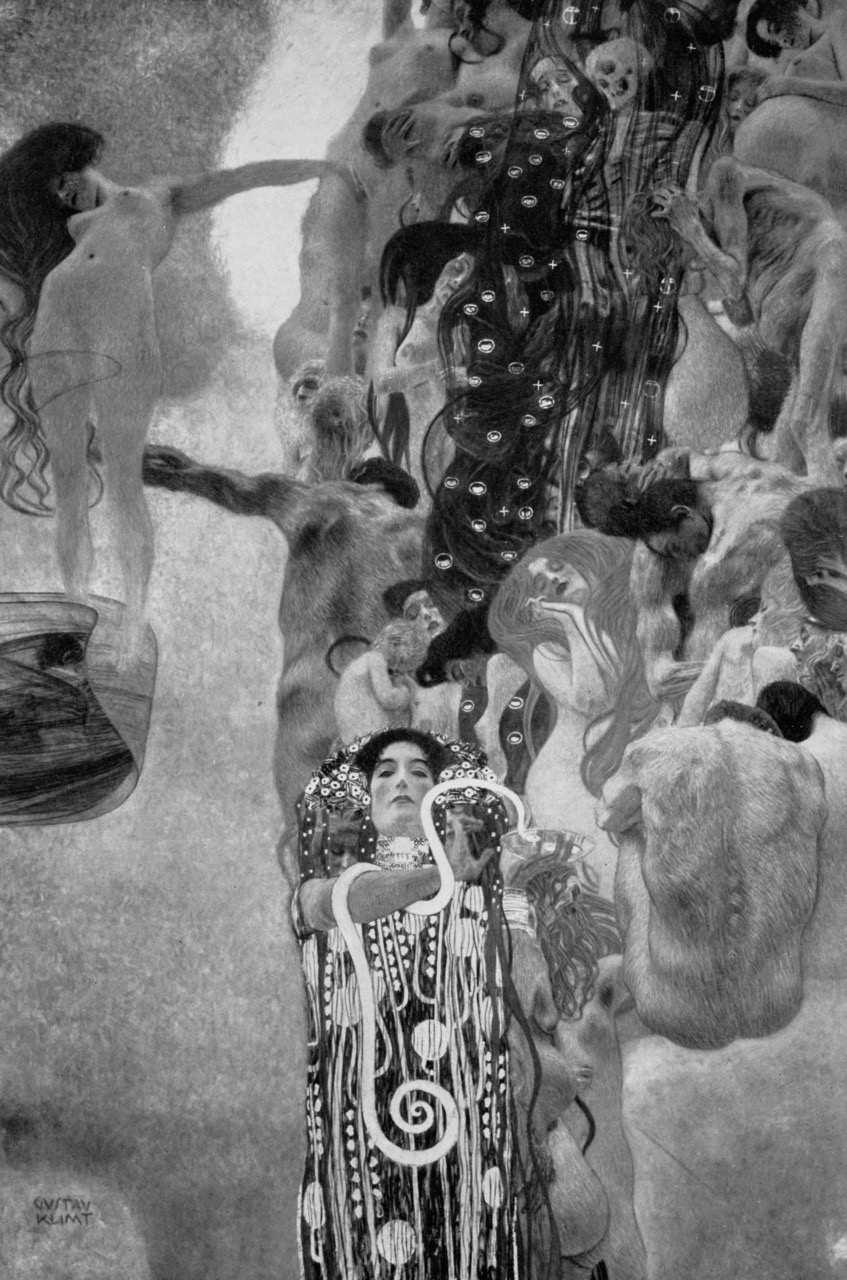
In 1894 the Imperial and Royal Ministry of Education commissioned Klimt and Franz Matsch to paint the ceiling of the ceremonial hall at the University of Vienna. Klimt took Philosophy, Medicine and Jurisprudence, each canvas around four metres by three. Matsch painted Theology, which the university still owns.
When Medicine was shown at the tenth Secession exhibition in 1901, its nudes set off a public fight, and professors at the university signed a petition against installing the paintings at all. In 1905 Klimt withdrew from the commission and gave up his fee, which also meant repaying the advances he had drawn. MedUni Vienna’s account follows the canvases from there. August and Serena Lederer covered the debts and took Philosophy; Koloman Moser bought Medicine and Jurisprudence between 1910 and 1912, and his family sold both on in 1919, Medicine to the Austrian Gallery and Jurisprudence to the Lederers.
The Lederers were Jewish, and after the Anschluss in 1938 their property was seized. For the duration of the war all three canvases were moved to Immendorf Castle in Lower Austria, an art depot. MedUni Vienna states what happened next: “On 8 May 1945, the castle and the artworks stored there were completely burnt out. Allegedly, retreating SS units set fire to the castle so as not to leave any works of art behind for the approaching Soviet troops.” Other accounts date the fire to 5 or 9 May. The day is unsettled. Nothing else about the outcome is.
No colour record survives beyond a single detail, the figure of Hygieia from Medicine in red and gold. Everything else is black-and-white photography and preparatory drawings. In 2021 the Belvedere worked with Google on machine-learning recolourisations built from those photographs, and hung them beside X-rays of surviving canvases in Gustav Klimt: Pigment & Pixel, at the Lower Belvedere from 20 February to 7 September 2025. Those images are reconstructions, and the museum labels them as reconstructions. Restitution law has nothing to offer here, because there is no object left to return.
What Adele Bloch-Bauer’s will actually said
Adele Bauer was born in Vienna on 9 August 1881, youngest of the banker Moritz Bauer’s seven children, and married the sugar industrialist Ferdinand Bloch on 19 December 1899, when he was seventeen years her senior. Her salon drew Gustav Mahler and the critic Berta Zuckerkandl. She died on 24 January 1925 at 43.
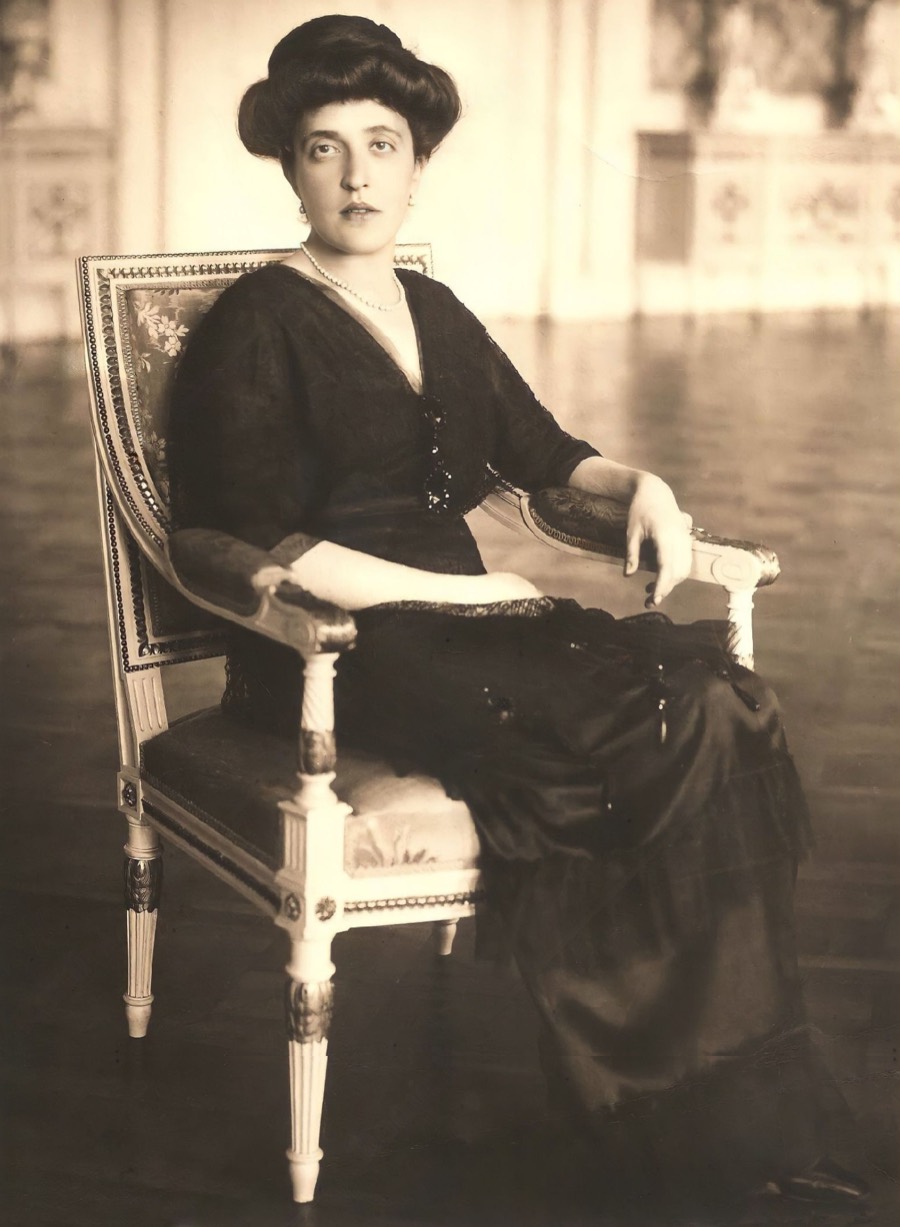
Ferdinand commissioned the first portrait in the summer of 1903, meaning it as an anniversary present for Adele’s parents that October, and Klimt did not put it on public view until early 1907. The Neue Galerie catalogues it as oil, gold and silver on canvas; the entry by Elana Shapira in the Jewish Women’s Archive gives the size as 140 by 140 centimetres. Adele is the only person Klimt painted twice at full length.
In 1923 Adele wrote a will asking Ferdinand to leave the Klimt paintings to the Austrian Gallery after his own death. Everything that happened eight decades later turned on how that sentence is read. It was addressed to her husband as a request, and the paintings were his property, bought with his money. A wish recorded in the will of someone who does not own the objects is not a bequest of them.
Ferdinand fled Austria after the Anschluss in March 1938 and never returned. The collection was taken. Working through the Nazi-appointed administrator Erich Führer, Portrait of Adele Bloch-Bauer I went to the Austrian Gallery in 1941, Portrait of Adele Bloch-Bauer II was sold to the same gallery in 1943, and Beechwood went to a Vienna museum. Ferdinand died in Zurich in November 1945, leaving his estate to his nieces and nephew. One of them was Maria Altmann.
In April 1948 the family’s lawyer accepted an arrangement: the heirs would treat Adele’s will as binding and leave six Klimts with the gallery, and in exchange the monuments authority would release export permits for other recovered works it was holding up. That agreement was the Austrian Gallery’s answer to the family for the next fifty years. The painting itself was renamed. The Neue Galerie, which owns it now, puts it this way on its own page: “For decades, the masterpiece was displayed in Vienna where it was renamed ‘Woman in Gold’ to conceal the sitter’s identity.”
What the US Supreme Court actually decided in 2004
Austria passed the Art Restitution Act in 1998, and the Belvedere’s provenance team began working systematically through every object made before 1945 and acquired since 1933, out of a collection of roughly 5,400 works. Dossiers go to the Commission for Provenance Research, then to the Art Restitution Committee, which recommends for or against return. The committee’s answer on the Bloch-Bauer Klimts was no. The Belvedere states it on its own provenance page: “In 16 cases involving 29 works of art, the Committee advised against restitution. Among these were the 5 Klimt pictures from the Bloch-Bauer collection, which have subsequently been restituted.” A far more famous disappearance, resolved in two years, not decades, and by a tip-off rather than a tribunal, is covered in the Mona Lisa's 1911 theft.
Maria Altmann filed in Austria in September 1999 and withdrew, because the court fee was calculated on the value of the paintings and came to something near 1.6 million dollars. She sued in federal court in California on 22 August 2000 instead, won on jurisdiction on 4 May 2001, and held that win in the Ninth Circuit on 12 December 2002. Austria appealed.
Republic of Austria v. Altmann, No. 03-13, was argued on 25 February 2004 and decided on 7 June 2004, by six votes to three, with Justice Stevens writing for the majority. The question was narrow. Does the Foreign Sovereign Immunities Act of 1976 reach conduct from before it was passed? The syllabus gives the holding in a single sentence: “The FSIA applies to conduct, like petitioners’ alleged wrongdoing, that occurred prior to the Act’s 1976 enactment and even prior to the United States’ 1952 adoption of the so-called ‘restrictive theory’ of sovereign immunity.”
That is the whole of the holding. Altmann could sue a foreign state in an American court over conduct dating to 1948. The Court expressly declined to review whether the expropriation exception in section 1605(a)(3) applied. It said nothing about who owned the paintings and ordered nothing returned. The ruling unlocked a courtroom door, which is not the same as opening a crate.
Retellings compress this, including the one published by the museum that owns the picture. The Neue Galerie’s page says: “In 2005, a panel hearing before the United States Supreme Court determined that the paintings were to be restituted to the heirs.” The Court ruled in June 2004, and what it ruled on was jurisdiction.
The decision that actually moved the paintings
With the jurisdictional obstacle cleared, Altmann and Austria agreed to put the ownership question to binding arbitration in Austria under the 1998 Art Restitution Act. Three Austrian jurists sat on the panel: Peter Rummel as chair, with Andreas Nödl and Walter H. Rechberger. Their award is dated 15 January 2006 and was made public the following day. The full text sits in specialist arbitration databases rather than on the open web, so the reasoning is harder to check than the outcome.
The outcome is not in doubt. The panel found for the heirs on five paintings: Portrait of Adele Bloch-Bauer I of 1907, Portrait of Adele Bloch-Bauer II of 1912, and three landscapes, Beechwood, Apple Tree I and Houses at Unterach on the Attersee. Austria complied. By 4 April 2006 all five hung at the Los Angeles County Museum of Art, which showed them until 30 June and noted they had never been exhibited together in the United States.
A sixth Klimt in the claim went the other way. The unfinished Portrait of Amalie Zuckerkandl stayed in Vienna, because whose property it had last been, Bloch-Bauer’s or Zuckerkandl’s, could not be established. Austria’s Supreme Court rejected extraordinary appeals against that result in April 2008, and the painting is still at the Belvedere. Any account that has the family recovering the Klimts is a painting short.
135 million dollars, then 192.7 million
On 19 June 2006, Ronald S. Lauder bought Portrait of Adele Bloch-Bauer I in a private sale for a reported 135 million dollars, the highest figure publicly reported for a painting to that date. It passed the 104.1 million dollars paid at auction for Picasso’s Boy with a Pipe in 2004. The portrait went to the Neue Galerie in New York, which Lauder co-founded and which credits the acquisition to Lauder, the heirs of the Bloch-Bauer estates and the Estée Lauder Fund.
The other four were consigned to Christie’s in New York and sold on 8 November 2006. Portrait of Adele Bloch-Bauer II made 87,936,000 dollars. Birch Forest made 40,336,000, Apple Tree I 33,056,000 and Houses at Unterach on the Attersee 31,376,000. The four together came to 192,704,000 dollars inside an evening sale that totalled 491,472,000, then the largest auction result on record.
These two events get welded into one constantly, including by search engines summarising the story. Adele Bloch-Bauer I never went under the hammer. It was sold privately in June and was not in the November auction. Oprah Winfrey bought Adele Bloch-Bauer II at Christie’s and sold it privately about a decade later, reported by Bloomberg in February 2017 at around 150 million dollars to a buyer in China; the Jewish Women’s Archive now records that painting’s location as a private collection in China. Private figures are reported rather than published, which is worth remembering whenever a Klimt appears in a ranking of the most expensive paintings sold.
Same collection, opposite outcome
Restitution decisions do not run on one rule, and the Lederer collection points both ways. Klimt’s Beethoven Frieze was painted for the fourteenth Secession exhibition of 1902 and meant to be destroyed when the show came down. Carl Reininghaus bought it in 1903 and had it cut into eight pieces to get it off the wall, then sold it to August Lederer in 1915.
The Secession’s own history records what followed. The Lederer family was expropriated in 1938 and the frieze passed into state administration. After the war it went back to the heir, Erich Lederer, by then living in Geneva. The Republic of Austria bought it in 1972, after Chancellor Bruno Kreisky intervened personally. In 2013 Erich Lederer’s heirs asked for it back, and in 2015 the Art Restitution Committee reviewed the claim under the amended Art Restitution Act and recommended against restitution. The frieze has been on permanent display in a purpose-built basement room at the Secession since 1986, in the building it was painted for.
So one Klimt from the Lederer collection burned at Immendorf while another survived, went back to the heir, was bought by the state, and was refused when the next generation asked again. Five Bloch-Bauer Klimts were refused by the same committee and awarded to the family by arbitrators seven years later. A sixth stayed where it was.
To check any of this rather than take it on trust, start with the Belvedere’s Sammlung Online records, which carry the inventory number, the full medium line and a footnoted catalogue essay with archival citations. The Kiss is inventory 912, in the Upper Belvedere; the Leopold Museum holds Death and Life and a group of Attersee landscapes. The Austrian federal provenance portal publishes the Art Restitution Committee’s recommendations, which is where a painting’s restitution history lives.