Two questions that place almost any Van Gogh
Van Gogh painted for about ten years. His first attempt at a still life in oils dates from 1881, his last canvases from July 1890, and nearly everything the public recognises was made in the final four of those years. That compression is what makes his output confusing. Hang a room of it in chronological order and it looks like a group show.
Most guides to his paintings sort them by fame. Sorting them by paint works better, because his materials changed on a schedule you can date, and he wrote the changes down while they were happening. The complete correspondence has been published and is searchable letter by letter, edited over fifteen years of work at the Van Gogh Museum and the Huygens Institute. Conservation scientists have separately measured what is physically sitting on the canvases.
So two questions will place almost any painting of his. Where does it fall in the decade? And what has the paint done since he stopped touching it? The first has an answer in his own handwriting. The second has an answer in a laboratory report, and it is odder than most people expect. Institutional judgment can diverge from popular reputation for other painters just as sharply: John Martin's paintings drew paying nineteenth-century crowds and even a pirated diorama, yet the Royal Academy still rejected his last trilogy as vulgar.
The Dutch work is not a painter who had yet to learn colour
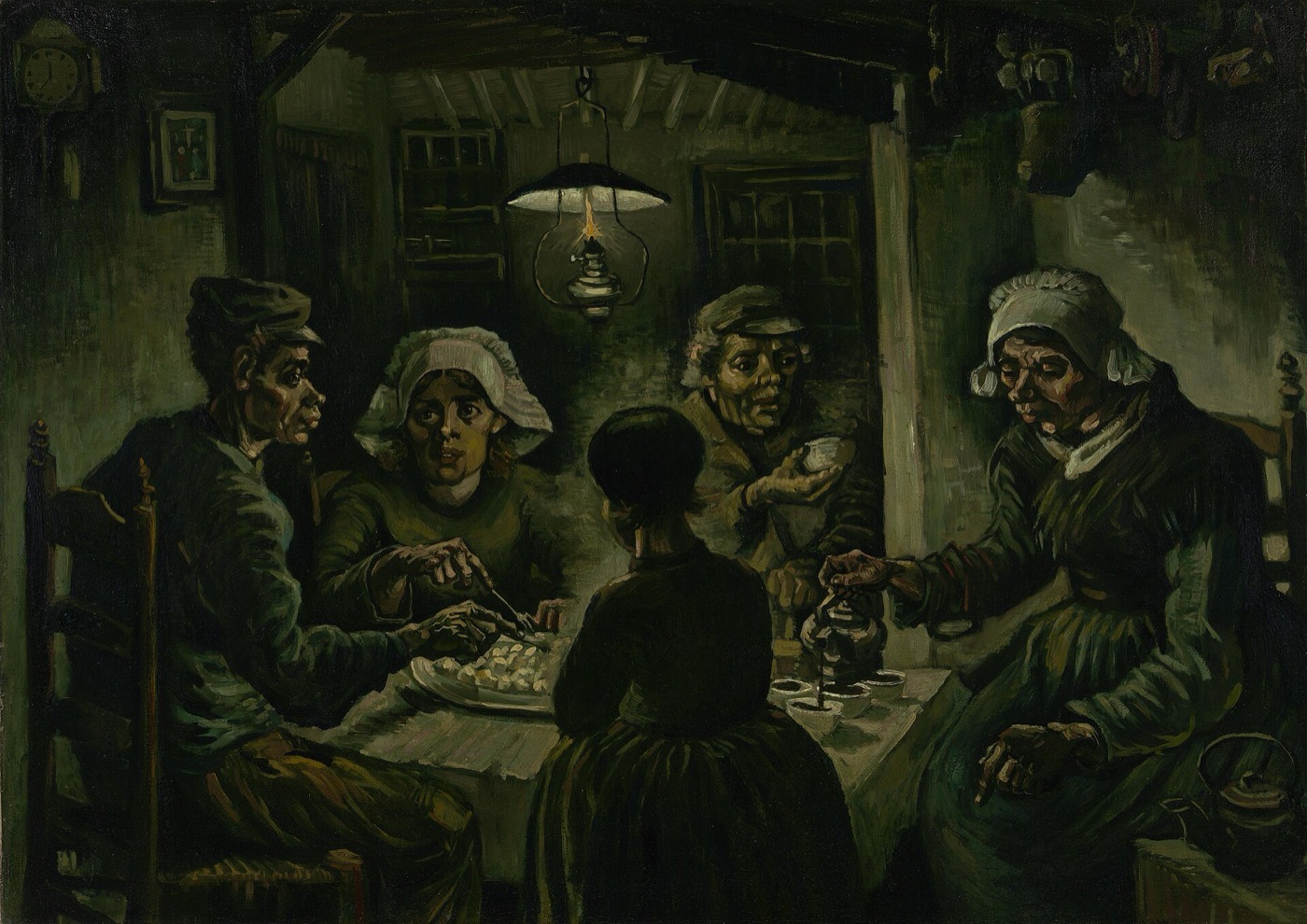
The Potato Eaters is the picture people reach for when they want to show how far he travelled. The Van Gogh Museum dates it Nuenen, April to May 1885, oil on canvas, 82 by 114 cm. It is brown and dim, with shadows worked up towards green-black, and it was finished three years before the Sunflowers.
The standard explanation is that he had not learned about colour yet. His own account of the painting says the opposite. Writing to Theo around 2 May 1885, he points out that the white in the picture contains almost no white paint: "in the white, for instance, white has hardly been used at all but simply the neutral colour that occurs if one mixes red, blue, yellow together" (letter 499). He names the three he mixed, vermilion, Paris blue and Naples yellow. The faces got the same treatment after he scraped back a first version he judged too light, ending up "something like the colour of a really dusty potato, unpeeled of course".
That is a colour system, and a demanding one to hold together across a large canvas. He was deliberately mixing complementary pairs down to neutrals, which was the method he had absorbed from Anton Mauve and the Hague School painters, known at home as the Grey School. What the early work is missing is not theory. It is pigment.
Paris turned the palette, and he described it in his own English
He moved to Paris in 1886, where Theo managed a branch of the Goupil gallery on the Boulevard Montmartre. Theo introduced him to Monet's work and, through Fernand Cormon's studio, to a younger circle that included Toulouse-Lautrec and Emile Bernard.
One letter from that autumn is worth more than any summary of the period, because Van Gogh wrote it in English himself, so nothing sits between his phrasing and ours. To the painter Horace Mann Livens, from Paris in September or October 1886: "In Antwerp I did not even know what the Impressionists were, now I have seen them and though not being one of the club, yet I have much admired certain Impressionist pictures" (letter 569). He then sets out what he is working on, and his own capitals survive in the manuscript. He is painting flowers, "seeking oppositions of blue with orange, red and green, yellow and violet, seeking THE BROKEN AND NEUTRAL TONES", and, a few lines later, "Trying to render intense COLOUR and not a grey harmony."
Set that last phrase against the Grey School and it stops sounding like a stylistic aside. He is naming the tradition he trained in and announcing that he is done with it. The same two years brought him Seurat, whose dotted technique he tried out and then loosened into his own alternation of dots and lines, and a large collection of Japanese woodcuts that he and Theo bought while the Paris market was flooded with them. Then the city wore him down. He took an overnight train south and reached Arles on 20 February 1888.
The April 1888 paint order is the hinge
Six weeks after he arrived, a paint delivery caught up with him from Paris, and his thank-you note to Theo is probably the most useful dating document in the whole correspondence. Writing from Arles on or about 11 April 1888, he lists what came: "the 3 chromes (the orange, the yellow, the lemon), the Prussian blue, the emerald, the madder lakes, the Veronese green, the orange lead, all of that is hardly found in the Dutch palette" (letter 595). He then names the painters whose palettes lack them, Maris, Mauve and Israëls, which is to say the circle he had come out of.
Most of these were products of nineteenth-century industry, not the traditional colourman. The chromes are lead chromates, cheap and startlingly bright. The lakes are organic dyes precipitated onto an inert base, which is exactly what makes them fugitive. And in the same letter, underlined in the manuscript, comes a sentence that reads very differently now than it did then: "all the colours that Impressionism has made fashionable are unstable, all the more reason boldly to use them too raw, time will only soften them too much." In the decades that followed, another painter organised his materials around a single motif, not a single palette, a programme traced in Monet's Water Lilies series.
He knew. He bought them anyway, and his stated compensation was to lay them on unmixed and thick so that there would be more colour to lose.
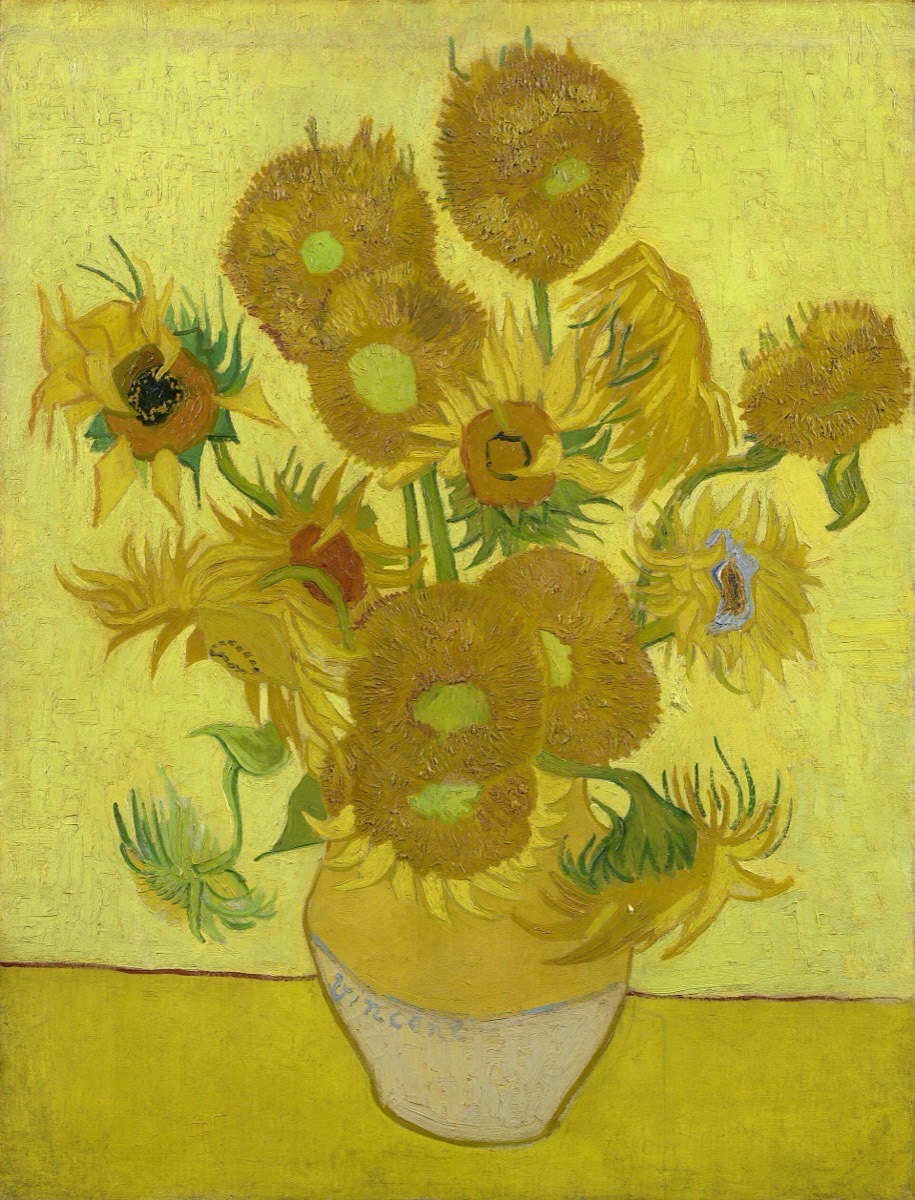
Nine months later he told the Dutch painter Arnold Koning precisely what had gone into the sunflower canvases of the previous summer: "Painted with the three chrome yellows, yellow ochre and Veronese green and nothing else" (letter 740, Arles, on or about 22 January 1889). Three yellows off that April invoice, one ochre, one green.
This yields a rule that works standing in a gallery without a label. A canvas built on unmixed chrome yellow and Veronese green belongs to Arles or later. A canvas built on mixed earth neutrals is Dutch. The Paris pictures sit between the two, lighter than Nuenen and less flat than Arles.
What the paint has done since
His own warning turned out to be accurate, and the museum holding the largest collection of his work has spent years quantifying how accurate.
A project called REVIGO, short for REassessing VIncent van GOgh, ran for four years and finished in 2017. It brought together the Van Gogh Museum, the Cultural Heritage Agency of the Netherlands, Delft University of Technology, Tilburg University, the Rochester Institute of Technology and the paint manufacturer AkzoNobel, funded by the Dutch research council. The method was unusually literal. Pigments were identified on the canvas by X-ray fluorescence and from minute samples, the surface was recorded with a hyperspectral camera so that every pixel carried its own colour data, and then the pigments themselves were remade from old recipes and ground in linseed oil pressed specifically for the project. Those fresh paints were brushed onto opacity cards and measured, giving the team a reference for how each mixture looked when new. Software then ran the ageing backwards for each of about a million and a half points on one painting.
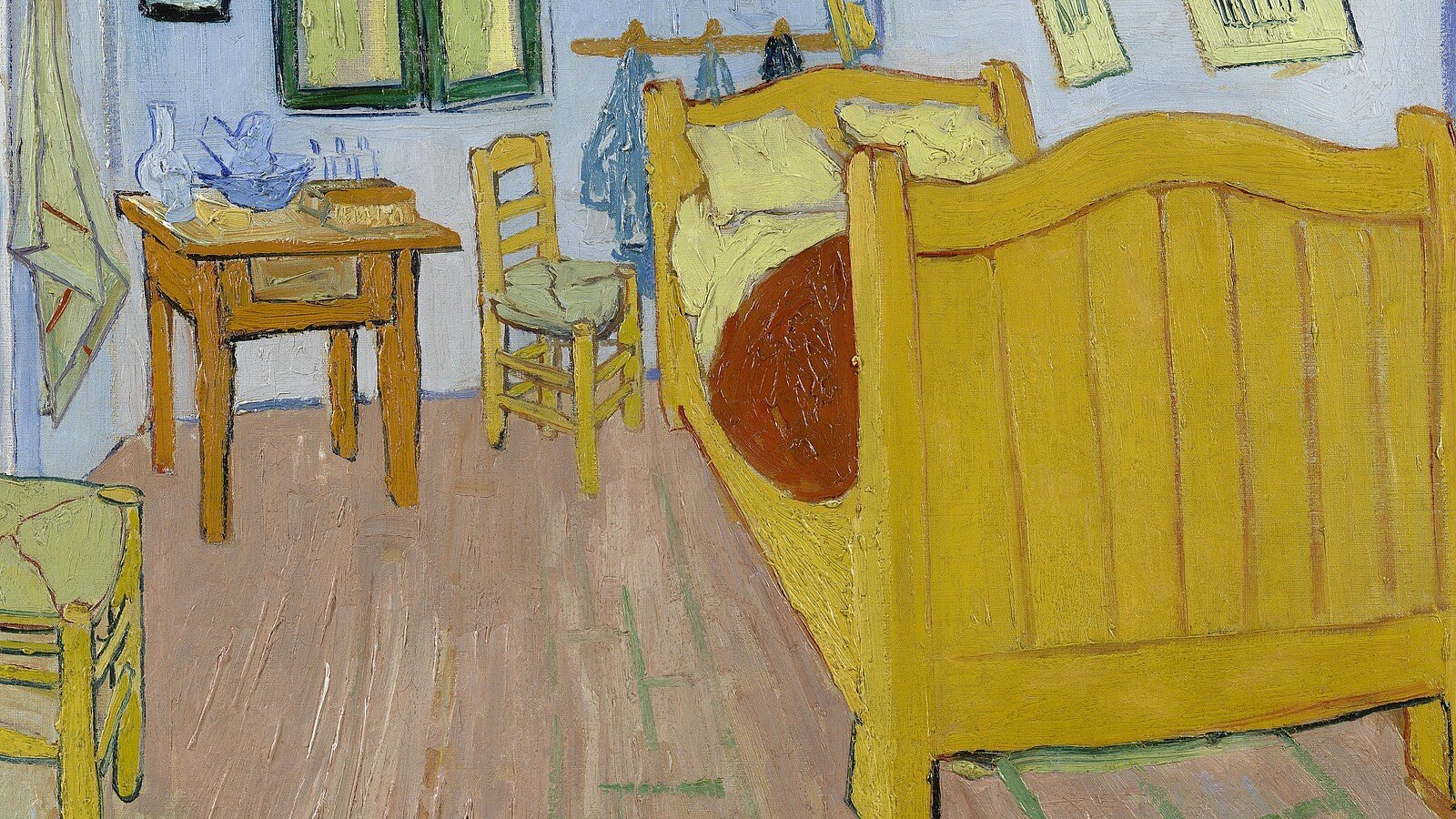
The Bedroom is the easiest result to check for yourself, because Van Gogh sent Theo a written colour key with a sketch of the picture on 16 October 1888. "The walls are of a pale violet." "The bedstead and the chairs are fresh butter yellow." "The doors lilac." (letter 705). Stand in front of the canvas today and the walls and doors are blue. The museum says so in its own catalogue entry: they were originally purple. The red lake he mixed into them faded out, and the blue left in the mixture took over the passage.
Field with Irises near Arles received the full reconstruction. He described the motif to Emile Bernard around 22 May 1888 as "that sea of yellow flowers with a line of purple irises" (letter 612). The irises now read blue and the field behind them is weaker than he painted it. Even the scattered white dots in the background turned out to have started pink, with the red surviving only deeper in the paint layer where a microscope can find it. The reconstruction matches his written description better than the painting on the wall does.
Sunflowers in Amsterdam went through a separate investigation beginning in 2016, led by the conservator Ella Hendriks with teams from Antwerp, Perugia, Toruń and the Dutch heritage agency. Her summary, in the museum press release of 24 January 2019: "We now know that the colour changes in Sunflowers are mainly caused by a certain type of red paint (geranium lake) fading and a certain type of yellow paint (chrome yellow) darkening". The chemistry behind the second half of that sentence was published in Angewandte Chemie in 2015. Van Gogh used more than one kind of chrome yellow, and the sulfur-rich variety reduces under light into chromium(III) compounds, which is what browns the paint film. The museum cut its maximum lighting level by two thirds in response, from 150 to 50 lux, and fitted LEDs with low output in the violet-blue-green part of the spectrum. It also announced that the painting would stop travelling.
Geranium lake is in that April 1888 order. So are the chromes. The pigments that made the Arles paintings possible are the same ones that have been rearranging them ever since. Van Gogh saw it happening to an earlier generation and wrote it down at Arles on 30 April 1889, after remembering some Delacroix canvases in a municipal museum: "The paintings fade like flowers" (letter 765). Landscape paintings face a parallel kind of myth-checking: three other 19th-century landscapes long read as faithful records of one real view turn out, on inspection of the sketches and sale records behind them, to have been spliced together, renamed, or barely sold at all.
Two things that get repeated about the body of work and are wrong
The first is the line that he sold one painting in his life. The Van Gogh Museum's own answer is that the number is unknown, "but in any case, it was more than a couple." His uncle Cor, an art dealer, commissioned nineteen cityscapes of The Hague. The Paris colourman Julien Tanguy bought a painting. Theo sold one to a London gallery. The Red Vineyard of 1888, now in the Pushkin Museum in Moscow, was bought by Anna Boch, sister of his friend Eugène Boch, and that is the transaction the myth is actually about: one sale out of a public exhibition to a buyer he was not related to. He also traded canvases for food and materials often enough that the museum counts it as selling.
The second is dating. Most secondhand pages give the Amsterdam Sunflowers as 1888. The Van Gogh Museum dates it Arles, January 1889, and the recent technical study supports that reading, since the composition was laid in as though he already knew exactly how the finished picture would look. It repeats the summer 1888 version now in the National Gallery, London. Five large canvases of a bunch of sunflowers in a vase exist by the museum's count.
If you want to verify anything about a specific painting, go to the object page at the institution that holds it. Each Van Gogh Museum entry carries an object number plus the two catalogue numbers used throughout the literature, an F-number and a JH-number. The Amsterdam Sunflowers is s0031V1962, F0458, JH1667. Searching one of those instead of a title removes most of the confusion, because he repeated subjects constantly and the versions ended up in different countries. Museums keep publishing exactly this kind of corrective record for other painters too: infrared and X-ray fluorescence studies have found that four of the best-known Renaissance paintings hide entirely different, abandoned designs underneath their finished surfaces.
A short method for looking
Mixed earth neutrals, tonal modelling, no unbroken colour anywhere. The Netherlands, before 1886. Complementary pairs are mixed down towards grey rather than set against each other.
A lightened palette, short broken strokes, and subjects that are cafés, riverbanks, flowers or himself. Paris, 1886 to February 1888. Models cost money he did not have, which is a large part of why the self-portraits cluster here.
Unmixed chrome yellow and green, flat areas of colour, firm outlines, cropping borrowed from Japanese prints. Arles onward, after February 1888.
Blue where the letters say violet, lilac or purple. Assume a faded red lake and add the red back in your head. This applies to a great many of the French paintings, not only the famous two.
A brownish cast creeping in at the edge of a bright yellow passage. Suspect chrome yellow reduction before you blame dirty varnish, though on the Amsterdam Sunflowers both are present at once.
None of this needs equipment. It needs the habit of checking the letter and the museum record instead of the caption, which is roughly the same habit conservators apply with better instruments.
Price is a separate record from the museum file. Van Gogh's Portrait of Dr. Gachet sold for $82.5 million at Christie's in 1990 and, according to a 2019 Daily Beast report, has not been seen in public since. How record painting prices have moved since 1987 lays out that sale next to the later ones.